Nazaré Big Waves Explained: Why the Biggest Waves in the World Break Here
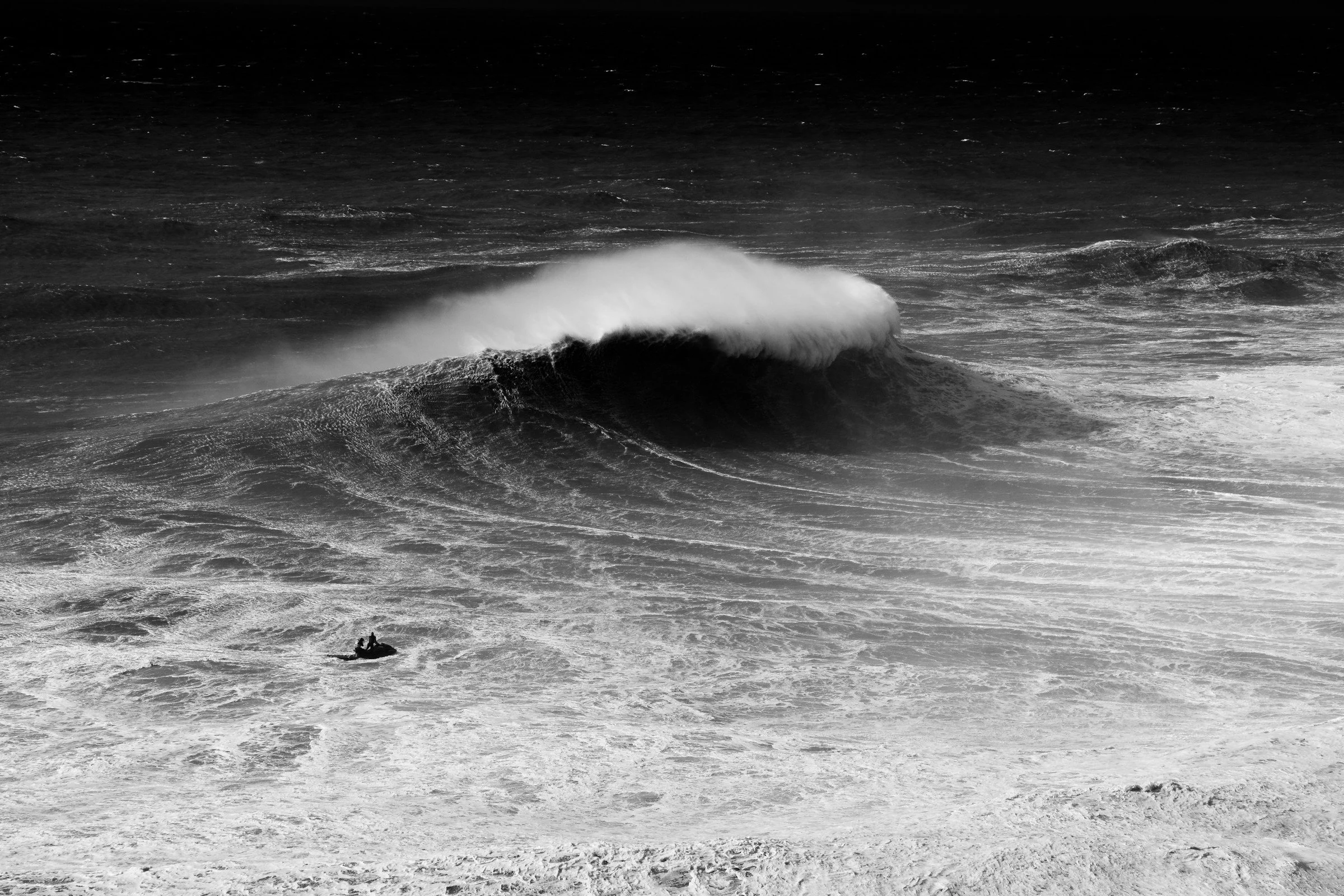
Nazaré, often referred to as the coliseum of big wave surfing.
For most of its history, Nazaré was defined by the sea in a very different way. Fishing shaped daily life, dictated risk, and demanded respect. Long before the town became a global reference for big wave surfing, locals already understood that the ocean here was not gentle and never predictable. What they did not yet know was that beneath the surface lay one of the most extreme wave-amplifying systems on the planet.
The reason Nazaré produces the biggest waves in the world has very little to do with luck and nothing to do with trends. It is the result of geology, scale, and deep-ocean mechanics working together in a way that exists almost nowhere else.
Off the coast of Nazaré runs the Nazaré Canyon, an immense underwater trench that stretches more than 200 kilometers into the Atlantic and reaches depths of over 5,000 meters. Unlike most coastlines, where the seafloor rises gradually as waves approach land, Nazaré allows deep-water swell to travel at full speed almost all the way to shore. The canyon channels energy forward, preserving power instead of dissipating it.
When that fast-moving swell suddenly meets the shallow continental shelf near Praia do Norte, the ocean has no space to release its energy smoothly. The result is compression. Waves slow abruptly, rise violently, and stack on top of themselves. This interaction is why waves in Nazaré do not simply break larger than usual; they grow exponentially, often appearing to double in size within seconds.
This is also why Nazaré waves feel unstable and unpredictable. Peaks shift. Takeoff zones move. Sets arrive with little warning. The ocean here does not unfold gradually. It surges.
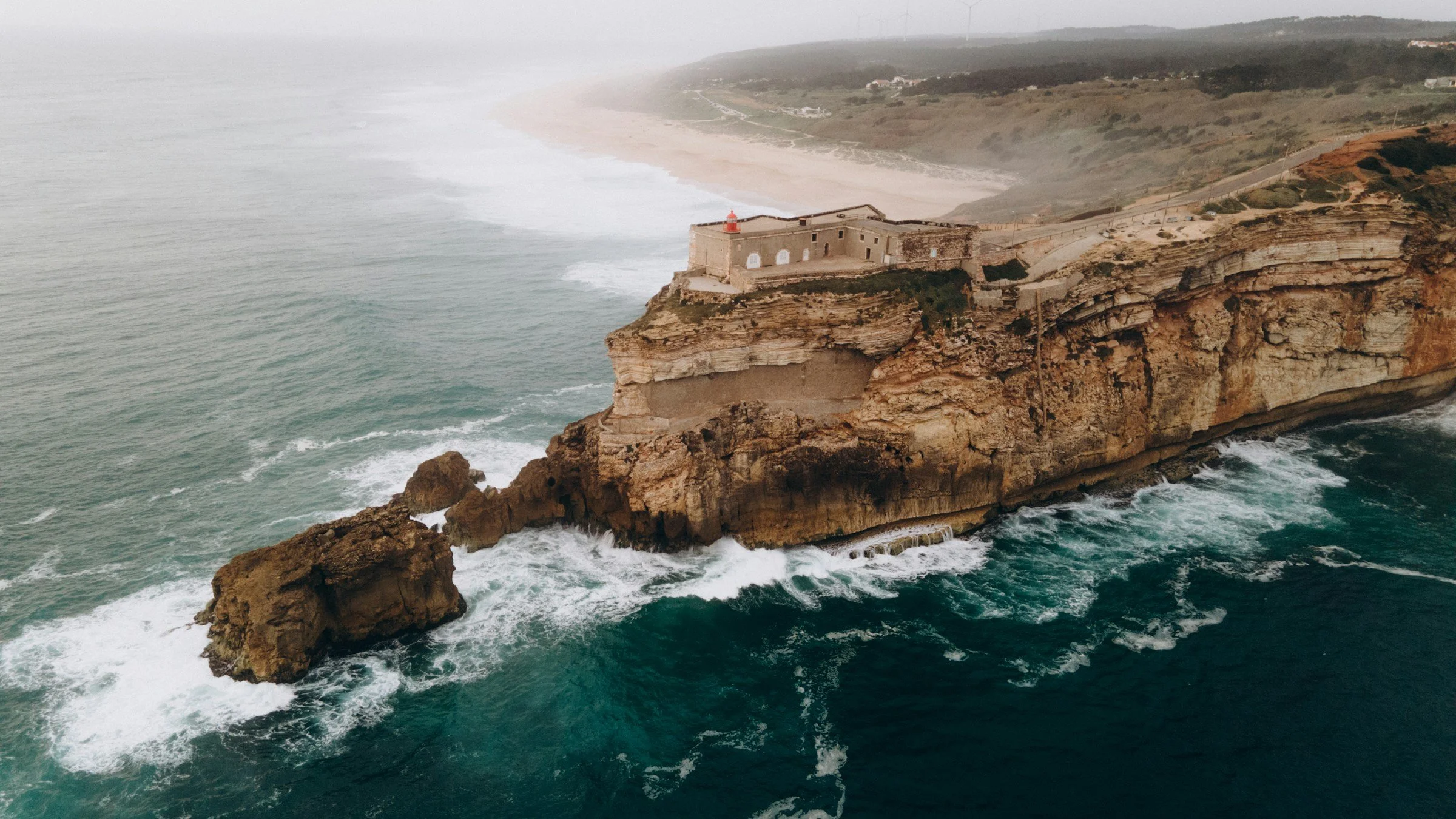
The Fort of São Miguel Arcanjo, a front-row seat to the world’s biggest waves.
The scale of these waves begins far from Portugal. Most Nazaré swells are born in powerful winter storms deep in the North Atlantic, sometimes near Greenland or the eastern coast of North America. These systems generate long-period swells that travel thousands of kilometers with enormous stored energy. When direction, period, and timing align with the canyon, Nazaré becomes the final expression of that journey.
Winter is essential. From roughly October to March, the Atlantic reaches its most active phase, and Nazaré enters its true season. Not every storm produces surfable waves, and not every big swell creates safe conditions, but when everything aligns, Nazaré transforms into a focal point for the global surf world. These are not casual sessions. They are windows that open briefly and close just as fast.
For decades, Nazaré was largely ignored by surfers. The waves were considered too chaotic, too dangerous, and too inconsistent to ride. Traditional paddling was impossible, and without an understanding of the canyon’s mechanics, the scale of the waves remained underestimated. That perception began to change in the early 2010s, when tow-in surfing and improved safety systems allowed surfers to explore what had previously been unreachable.
Surfers like Garrett McNamara helped bring Nazaré into global consciousness, not by conquering it, but by revealing it. The images that followed — walls of water, near-vertical faces, dramatic rescues — reshaped how the world understood Portugal’s coastline. Nazaré was no longer a footnote. It became a reference.

Garrett McNamara surfing Nazaré, during the early years of its global recognition. Source: WSL / Bruno Aleixo
What sets Nazaré apart from other big wave locations is not just size, but character. Many famous big wave spots rely on reefs or underwater structures that create relatively defined takeoff zones. Nazaré does not offer that clarity. Its waves shift constantly, breaking across wide areas, with impact zones that move from one set to the next. This instability increases danger and demands an extraordinary level of coordination between surfers, jet ski drivers, and safety teams.
At Nazaré, success is not measured by bravado. It is measured by preparation, restraint, and respect. Even the most experienced big wave surfers spend far more time waiting than riding. Conditions must align not only for wave size, but for wind, visibility, and rescue capacity. The ocean here does not reward impatience.
For most surf travelers, Nazaré is not a place to surf. It is a place to witness. Standing on the cliffs at Praia do Norte during a large swell offers perspective that no video can fully capture. The sound alone — the low, heavy thunder of water collapsing — reframes how you understand waves.
That perspective is part of Portugal’s strength as a surf destination. Nazaré represents the extreme end of a coastline that also offers accessible beach breaks, technical reefs, and learning environments. The same Atlantic that produces the world’s biggest waves also produces forgiving conditions elsewhere, depending on geography and timing.
This range is what makes Portugal unique. It is not defined by one type of wave, one level, or one season. Nazaré sits at the outer edge of that spectrum, a reminder of what the ocean is capable of when energy, depth, and land collide perfectly.
More than records or headlines, Nazaré has become a symbol. It represents the seriousness of the Atlantic, the importance of understanding natural systems, and the limits that cannot be negotiated. In a sport often driven by progression and performance, Nazaré reintroduces humility into the conversation.
The biggest waves in the world break here because the ocean allows them to. The canyon preserves energy. The storms deliver power. The coastline forces release. Human presence is secondary.
And that is exactly why Nazaré matters.
It does not invite participation from everyone.
It invites understanding.